From Turin to Florence and Bassano del Grappa, Italy’s finest pen makers transform the simple act of writing into an expression of craftsmanship, design and personal style
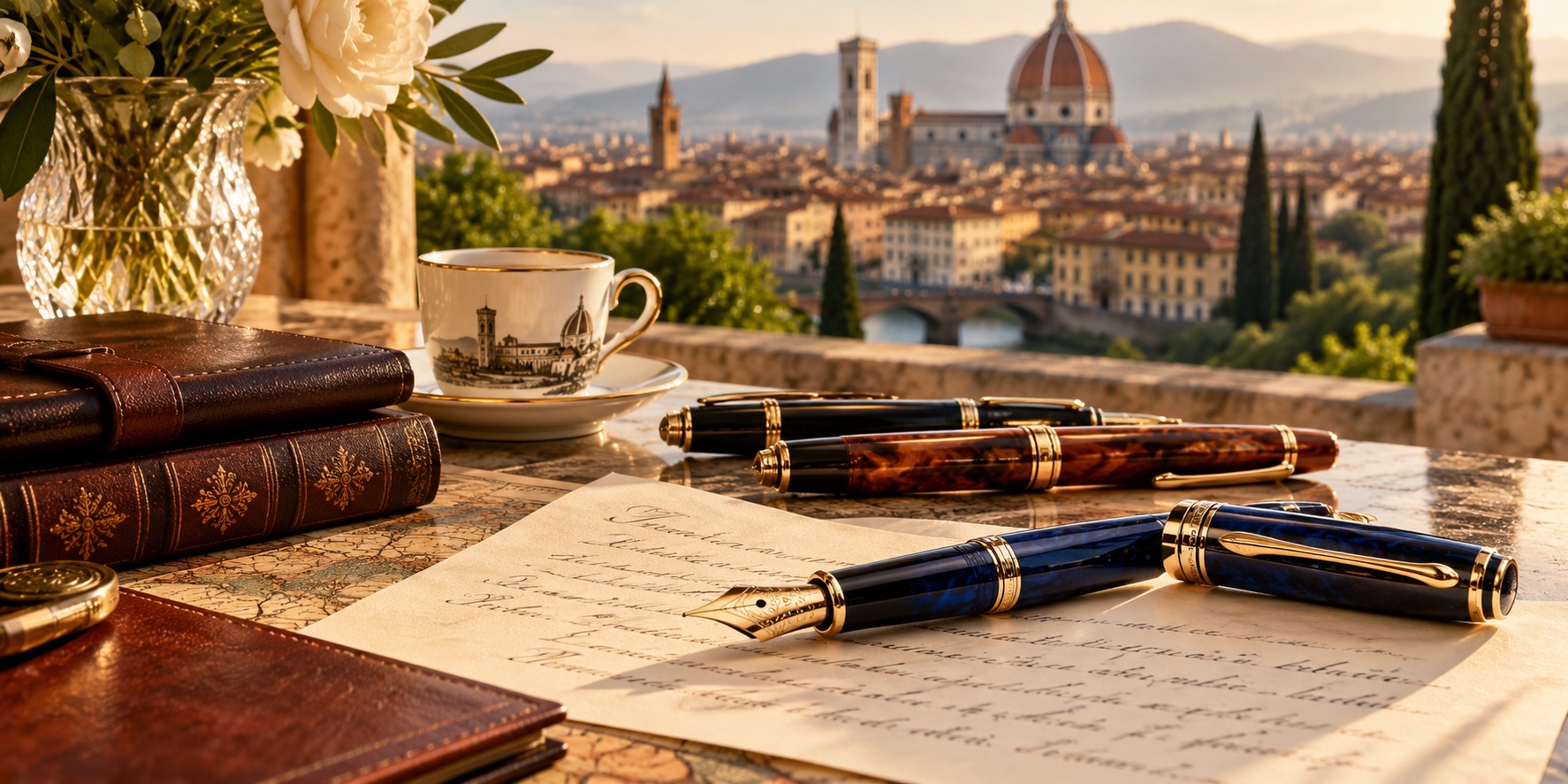
In an age dominated by smartphones, keyboards and instant messages, there is something decidedly luxurious about putting pen to paper.
A beautifully crafted Italian fountain pen does more than write. It has weight in the hand, personality in its design and a tactile quality that digital technology simply cannot reproduce. Like a handmade leather bag, mechanical watch or tailored Italian suit, a fine writing instrument represents a more deliberate approach to everyday life.
Italy has a remarkable heritage of pen making, with houses such as Aurora, Montegrappa, Visconti and Pineider combining traditional craftsmanship with the unmistakable creativity of Italian design.
For collectors, executives and anyone who appreciates the finer details of Made in Italy, these are names worth knowing.
Aurora: Turin’s Master of the Fountain Pen
Founded in Turin in 1919, Aurora has spent more than a century developing writing instruments that combine Italian industrial design with traditional craftsmanship. Every Aurora pen is produced at the company’s historic Turin manufacture, and the company remains notable for producing its own nibs in-house.
One of the house’s most celebrated designs is the Aurora 88, created by designer Marcello Nizzoli in 1947. According to Aurora, more than seven million examples have been sold, and the model remains in production today.
Other collections, including the Optima, demonstrate the brand’s characteristic combination of rich resins, elegant proportions and distinctly Italian color.
There is something particularly appealing about Aurora’s approach. These are luxury pens, certainly, but they are also intended to be used. An Aurora can become the pen kept on a desk for decades—the instrument used to sign important documents, write personal correspondence or simply record thoughts in a favorite notebook.
It is Italian functional luxury at its best.
Montegrappa: Italian Writing With a Collector’s Spirit
Few Italian pen makers possess the sense of occasion found at Montegrappa. Led by CEO Giuseppe Aquila since 1992 — his innovative leadership has grown the brand to impressive heights, esteem recognition and admiration.
The company’s origins date to 1912, when a group of industrialists established a fountain-pen factory in Bassano Veneto. Its manufacture remains in Bassano del Grappa today, in the artisanal heartland of the Veneto.
Montegrappa occupies an intriguing space between fine writing instrument, jewelry and collectible art.
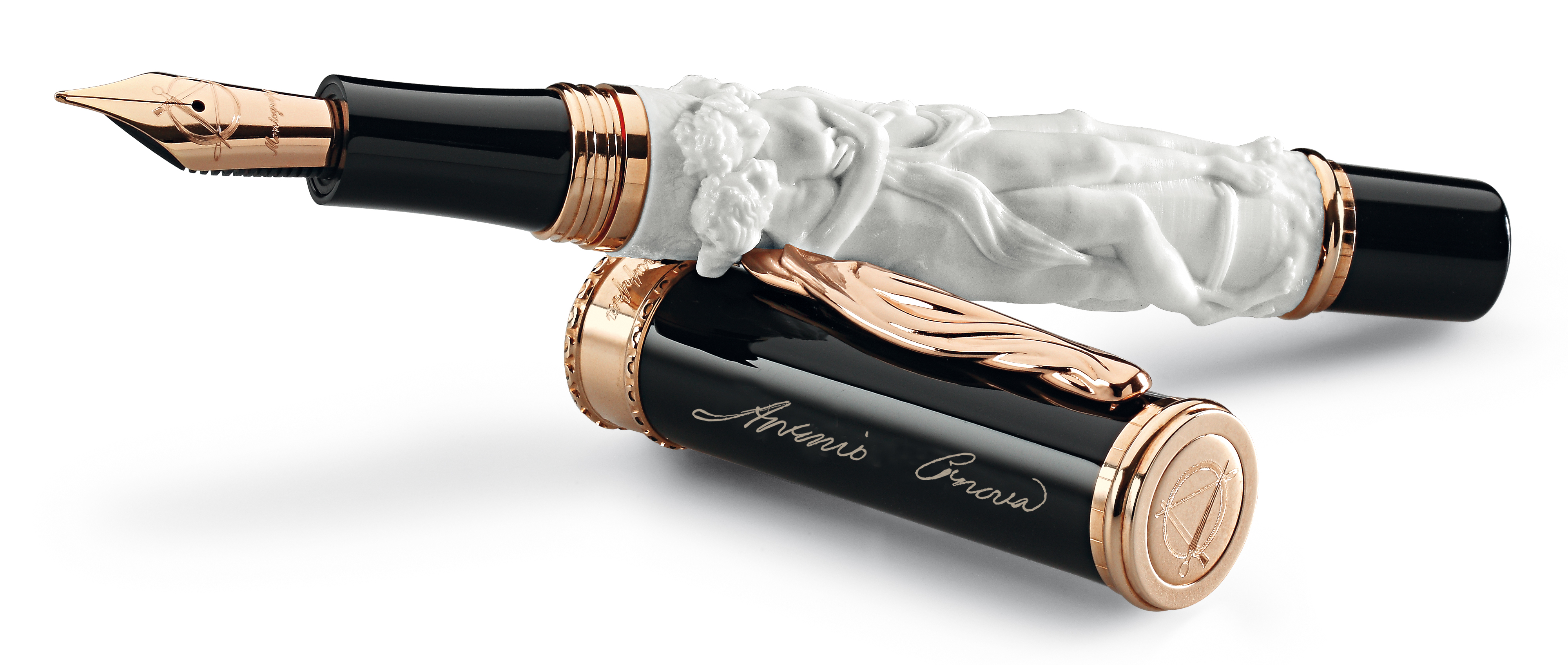
While the house produces understated pens suitable for everyday writing, it is particularly famous among collectors for elaborate limited editions that celebrate personalities, culture, history and imaginative themes.
Precious metals, intricate engraving, celluloid and elaborate sculptural details can turn certain Montegrappa creations into miniature works of art.
For someone accustomed to the craftsmanship of a fine mechanical watch, the appeal is immediately understandable. A Montegrappa is not merely purchased for utility; it can be collected, admired and eventually passed from one generation to another.
Visconti: Florence, Art and Innovation
If Montegrappa represents the theatrical side of Italian pen making, Visconti brings the artistic heritage of Florence to the writing desk.
Founded in Florence in 1988, Visconti built its identity around a combination of traditional craftsmanship, expressive materials and technical experimentation. The company has developed patented filling systems over the years, while its distinctive bridge-shaped clip takes inspiration from Florence’s Ponte Vecchio.
That Florentine identity runs throughout the brand.
One of its best-known creations is the Homo Sapiens, a collection whose Lava Bronze version became one of Visconti’s signature designs. The house has continued to develop its fountain-pen technology, including its Galileo Double Filler system introduced in 2024.
Visconti’s pens frequently feel expressive rather than conservative. Colors can be dramatic, materials unusual and designs unmistakably Italian.
For someone who wants a fountain pen with a strong visual personality, Visconti is difficult to overlook.
Pineider: Florentine Elegance Since 1774
While some pen companies begin with the writing instrument, Pineider begins with the culture of writing itself.
The Florentine house traces its history to 1774, when Francesco Pineider established the business in Florence. Its heritage encompasses fine paper, personalized printing, leather goods and, eventually, writing instruments.
Pineider flourished within a culture in which correspondence was an art. Fine stationery, beautifully printed invitations and handwritten letters were all markers of refinement.
That history gives Pineider a somewhat different character from other Italian pen houses.
A Pineider pen belongs naturally alongside monogrammed stationery, a leather writing case and an elegant desk. Its appeal is less about ostentation and more about ritual—the pleasure of choosing beautiful paper, uncapping a fine pen and taking the time to write.
Perhaps appropriately, Pineider itself describes its contemporary identity in terms closely associated with quiet luxury: refined, understated and rooted in craftsmanship.
Why Italian Pens Still Matter
The survival—and renewed appreciation—of fine writing instruments might seem surprising in our increasingly digital world. Yet that may be precisely why they matter.
We spend much of the day tapping glass screens and typing on keyboards. Handwriting forces us to slow down. The experience becomes physical again: the texture of paper, the movement of the nib and the flow of ink.
An Italian fountain pen turns that experience into a small daily luxury. And unlike many contemporary luxury purchases, a fine pen can develop a deeply personal history. It may sign a first business contract, write a wedding speech, record travel memories or compose letters that someone keeps for decades.
Scratches and traces of use do not necessarily diminish it. They become part of its story.
More Than a Pen: A Piece of Italian Lifestyle
The finest Italian writing instruments share many qualities with the country’s most celebrated fashion, automobiles, furniture and watches.
There is respect for tradition without being trapped by it. There is craftsmanship combined with innovation. And above all, there is an understanding that useful objects can—and perhaps should—also be beautiful.
Aurora represents the precision and design heritage of Turin. Montegrappa carries the artisanal traditions of the Veneto into the world of collectible luxury. Visconti channels Florence’s artistic character through inventive contemporary writing instruments. Pineider connects today’s pen enthusiast to more than two centuries of Florentine stationery and craftsmanship.
Different histories. Different personalities. One distinctly Italian philosophy.
Because in Italy, even something as simple as writing can become an art. And la dolce vita, after all, is often found in the details.