A Soft Soundtrack for Living Life Italian Style and at Peace
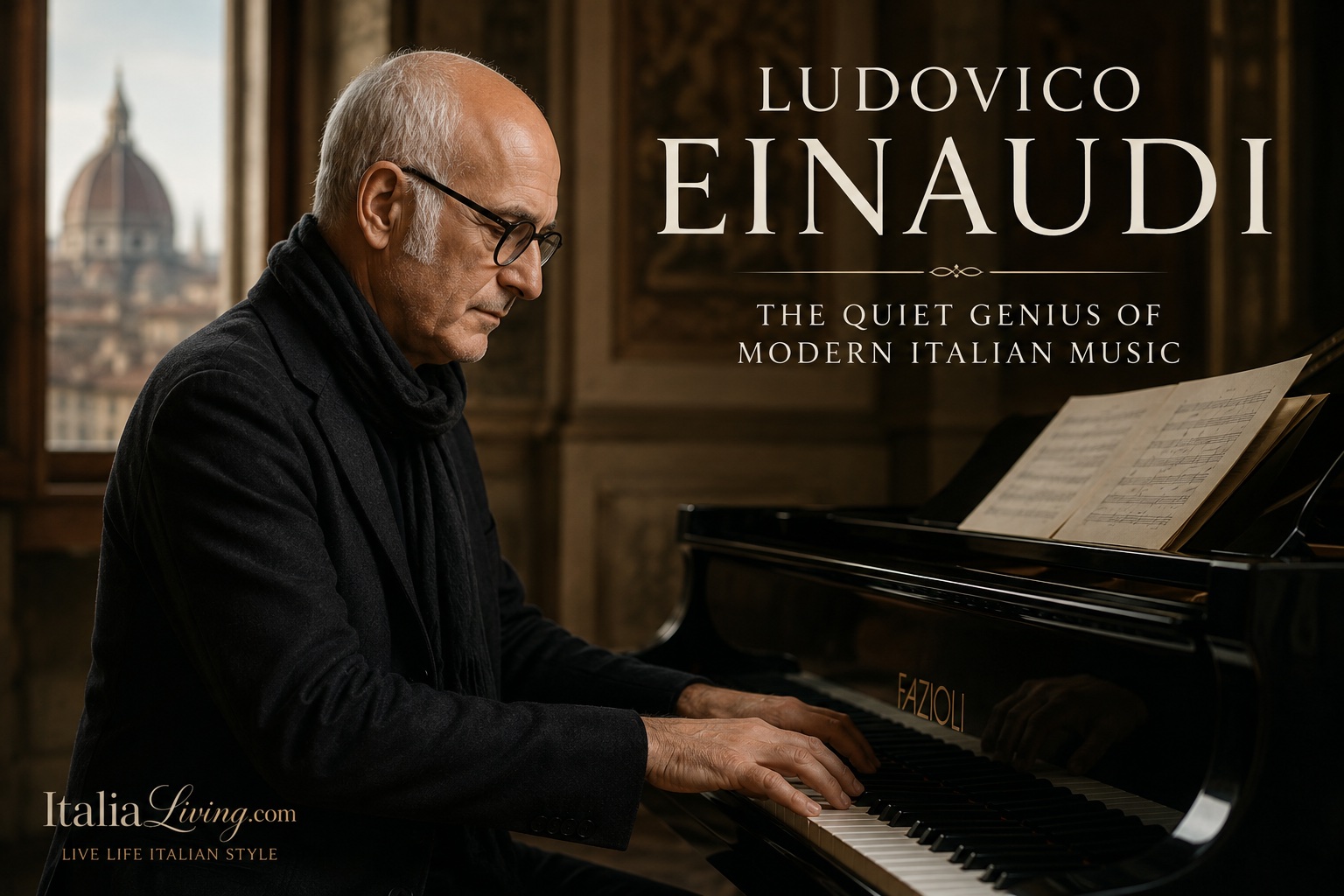
In a world increasingly filled with noise, few contemporary composers have mastered the beauty of simplicity quite like Ludovico Einaudi. With delicate piano melodies, subtle repetition and an unmistakable sense of atmosphere, the Italian pianist and composer has created a musical language that feels at once modern and timeless.
Born in Turin, Italy, on November 23, 1955, Einaudi has become one of Italy’s most internationally recognized contemporary composers and pianists. His music crosses the traditional boundaries between classical, minimalist, ambient and cinematic music, reaching listeners who may rarely consider themselves classical music enthusiasts.
Yet beneath the apparent simplicity of his compositions lies an artist with deep roots in Italy’s classical tradition.
From Turin to the World
Music entered Einaudi’s life at an early age. His mother was an amateur pianist, providing an early musical influence. He began his formal studies at the Turin Conservatory before continuing at the Milan Conservatory, where he studied composition with Azio Corghi. He later refined his craft with influential avant-garde composer Luciano Berio, eventually becoming his assistant, and also studied with Karlheinz Stockhausen.
In 1982, Einaudi received a scholarship to the prestigious Tanglewood Music Festival in the United States, exposing him to emerging currents in American minimalism. His early career included works for orchestra, ballet and theater, with performances at institutions and venues including La Scala in Milan, IRCAM in Paris and Lincoln Center in New York.
Over time, however, Einaudi began moving toward something more personal: music stripped of unnecessary complexity, where a handful of notes could carry extraordinary emotional weight.
It was a journey toward the essential.
Finding Beauty in Simplicity
Einaudi’s music is often associated with minimalism, but describing it simply as “minimalist” doesn’t fully capture its appeal.
His compositions unfold gradually. A simple piano phrase repeats, changes almost imperceptibly and begins to build. Strings may enter. Electronic textures appear quietly in the background. The music grows and retreats like waves along an Italian shoreline.
There is space between the notes. And perhaps that space is part of what makes his music so powerful.
Rather than demanding attention, Einaudi’s compositions invite reflection. They can evoke melancholy without becoming sad, romance without becoming sentimental and hope without becoming triumphant.
It is music that seems designed to accompany memories.
Le Onde and an International Audience
An important turning point came with Le Onde, Einaudi’s first solo-piano album. Inspired by the writing of Virginia Woolf, the project helped introduce his distinctive musical voice to a much wider international audience.
Albums including Eden Roc and I Giorni followed, with the latter inspired by a journey to Mali. Einaudi later returned to Africa and recorded Diario Mali with celebrated kora musician Ballaké Sissoko.
His willingness to absorb influences outside the traditional European classical world became an important part of his identity.
Einaudi was creating contemporary Italian music without being confined by conventional definitions of what Italian classical music was supposed to sound like.
The Music That Became Modern Classics
For many listeners, discovering Einaudi begins with one unforgettable composition.
Perhaps it is the haunting beauty of “Nuvole Bianche.” Or the gentle meditation of “I Giorni.” —two of my very favorites if I had to pick.
For others, it is “Una Mattina,” “Divenire,” “Experience“ or one of the many compositions that have become familiar through cinema, television and streaming playlists.
His 2004 album Una Mattina presented an increasingly introspective musical world, while Divenire expanded his sound through orchestral textures. Both achieved success beyond traditional classical audiences, entering pop charts as well as classical charts.
Later albums continued the evolution. Nightbook explored darker, more nocturnal territory. In a Time Lapse, released in 2013, became a meditation on time, combining piano with strings, percussion and electronics.
Elements followed in 2015, drawing inspiration from ideas ranging from geometry and mythology to the writings of artist Wassily Kandinsky.
Then came one of Einaudi’s most ambitious projects.
Seven Days Walking
Einaudi found inspiration for Seven Days Walking during winter walks through the mountains.
Rather than creating a conventional album, he developed an extraordinary seven-part musical project, releasing seven albums between March and October 2019. The compositions explore variations surrounding an imagined journey, almost as though the listener is repeatedly walking the same path while experiencing something slightly different each time.
It is quintessential Einaudi. Nature, silence, movement and repetition become part of the composition itself.
That relationship between music and landscape would later become even more literal. In 2021, Einaudi staged a series of concerts surrounded by nature in Italian parks, valleys, lakes, reserves and other remote landscapes, with some locations accessible only on foot.
The idea feels distinctly Italian: music not separated from life, but experienced alongside landscape, beauty and place.
Music for the Cinema
Even those unfamiliar with Einaudi’s name may have heard his music.
His compositions have appeared extensively in cinema and television, helping introduce his work to millions of listeners around the world. His screen work and musical appearances include productions such as This Is England, The Intouchables, Nomadland and The Father.
Cinema seems particularly suited to Einaudi because his music possesses a rare ability to create emotion without dictating exactly what the listener should feel.
The piano becomes another character. A few repeating notes can suggest longing, uncertainty, memory or possibility. It is cinematic music even when no film exists around it.
Music and the Italian Landscape
There is also something unmistakably Italian about Einaudi’s relationship with place.
His music may not sound like traditional Italian opera or the grand symphonic works associated with earlier centuries, but it shares Italy’s long tradition of finding emotional meaning in beauty.
Mountains, changing light, architecture, water, silence and nature frequently seem to inhabit his musical world.
One particularly memorable example came with “Elegy for the Arctic,” which Einaudi performed on a floating platform surrounded by Arctic ice as part of a Greenpeace initiative.
The performance demonstrated something central to his artistic philosophy: music does not necessarily need a grand concert hall to feel monumental.
Sometimes a piano, a landscape and silence are enough.
Underwater: Returning to the Piano
During the unusual stillness of the pandemic lockdown, Einaudi returned to an especially intimate relationship with his instrument.
The result was Underwater, released in 2022, a solo-piano album conceived during a period when the outside world had suddenly become quieter. Einaudi described the title as a metaphor for a sense of fluidity and freedom from outside interference.
The album brought his music back to its most essential elements: composer, piano and emotion.
It was a reminder that after decades of experimentation with orchestras, electronics, world music and cinematic soundscapes, Einaudi’s greatest instrument remains simplicity itself.
A Continuing Musical Journey
Einaudi’s creativity has hardly slowed. His official discography includes The Summer Portraits, released in 2025, alongside landmark recordings such as Underwater, Seven Days Walking, Elements, In a Time Lapse, Nightbook, Divenire, Una Mattina and I Giorni.
His work continues in 2026 with The Summer Portraits Live and Solo Piano, while his concerts continue to bring his music to audiences around the world.
It is remarkable for music this quiet to have achieved such global reach.
But perhaps that is precisely the point.
The Sound of a Different Italy
Italy’s musical heritage is extraordinary. The country gave the world Vivaldi, Verdi, Puccini, Rossini and countless other composers whose works helped define Western classical music.
Ludovico Einaudi belongs to a different era.
His Italy is not necessarily the Italy of grand opera houses and dramatic arias. It is an Italy experienced in quieter moments — walking through the mountains, watching afternoon light move across an old stone wall, sitting beside the sea or simply allowing yourself a few minutes of stillness.
His music reminds us that beauty does not always need to announce itself.
Sometimes it arrives quietly.
A piano begins.
A few notes repeat.
And suddenly the world feels a little slower.
For anyone drawn to the Italian philosophy of appreciating beauty, simplicity and the pleasures of the moment, Ludovico Einaudi offers something more than music.
He offers a soundtrack for living life Italian style.
Essential Ludovico Einaudi Listening
For those discovering his music for the first time, I suggest you begin with “Nuvole Bianche,” “I Giorni,” “Una Mattina,” “Divenire” and “Experience.” From there, explore the complete albums Le Onde, Una Mattina, Divenire, In a Time Lapse, Seven Days Walking, Underwater and The Summer Portraits.
Each reveals a different side of a composer who has made quietness one of the most recognizable sounds in contemporary Italian music.
Visit his website at: https://ludovicoeinaudi.com/
YouTube: https://www.youtube.com/@ludovicoeinaudi